Most crisis training is built around the individual. A major incident is not.
Responders complete their modules, pass their assessments and earn their certificates one person at a time. Then a real incident arrives, and success depends on something none of those assessments measured: how well people from different teams, shifts and organisations communicate, hand over and lead together under pressure.
That gap shows up again and again in inquiry reports. The individual skills were usually there. What failed was the coordination between them. This post looks at why team-based training matters, what multiplayer crisis simulations let organisations rehearse, and how emergency services, healthcare and utilities can use them to prepare for the incidents they hope never come.
What the Evidence Says About Failure
When major incidents go wrong, the post-mortem rarely points to one person who lacked a skill. It points to the spaces between people.
The second volume of the Manchester Arena Inquiry examined the emergency response to the 2017 attack, in which 22 people were killed. It found that commanders from police, fire and ambulance did not come together at a single location, and that critical information did not flow between the three services in the first hour. The principles that should have held the response together already existed on paper.
Those principles are set out by the Joint Emergency Services Interoperability Principles (JESIP), the UK framework for multi-agency working. It asks commanders to co-locate, communicate, coordinate, jointly understand risk and build shared situational awareness. Yet a 2016 tri-service review led by HMIC rated joint doctrine at level 2 of its maturity scale: it existed, but was not widely accepted or understood.
Healthcare tells a similar story. The Joint Commission reviewed 1,441 sentinel events in 2022, its category for the most serious patient safety incidents, and identified failures in communication and teamwork among the leading causes.
Utilities are no exception. Ofgem's investigation into the 9 August 2019 power outage covered an event that interrupted electricity supply to more than one million consumers and disrupted other services, including rail. The Energy Emergencies Executive Committee's interim report separately examined the communication protocols between the system operator, network operators, generators and government during the event.
Why Individual Training Leaves a Gap
Individual training answers an important question: does this person know what to do? It cannot answer the question that decides most incidents: can these people do it together?
A paramedic who knows triage protocols perfectly still has to agree priorities with a fire commander who sees different risks. A ward sister who knows the escalation pathway still has to hand over to a night team arriving mid-crisis. A control room engineer who knows the switching procedure still has to keep field crews, the press office and the regulator working from the same picture.
These are team skills: shared mental models, closed-loop communication, clear roles and the confidence to challenge a decision. They only develop when people practise with each other. E-learning cannot simulate a colleague misunderstanding an instruction. A single-user VR scenario cannot recreate the moment two commanders realise they are working from different maps.
Live exercises do rehearse these skills, but they are expensive, disruptive and infrequent. Bringing responders from several agencies to one site for a day happens a few times a year at best. That is rarely enough repetition to make good coordination a habit.
What Multiplayer Simulations Let Teams Rehearse
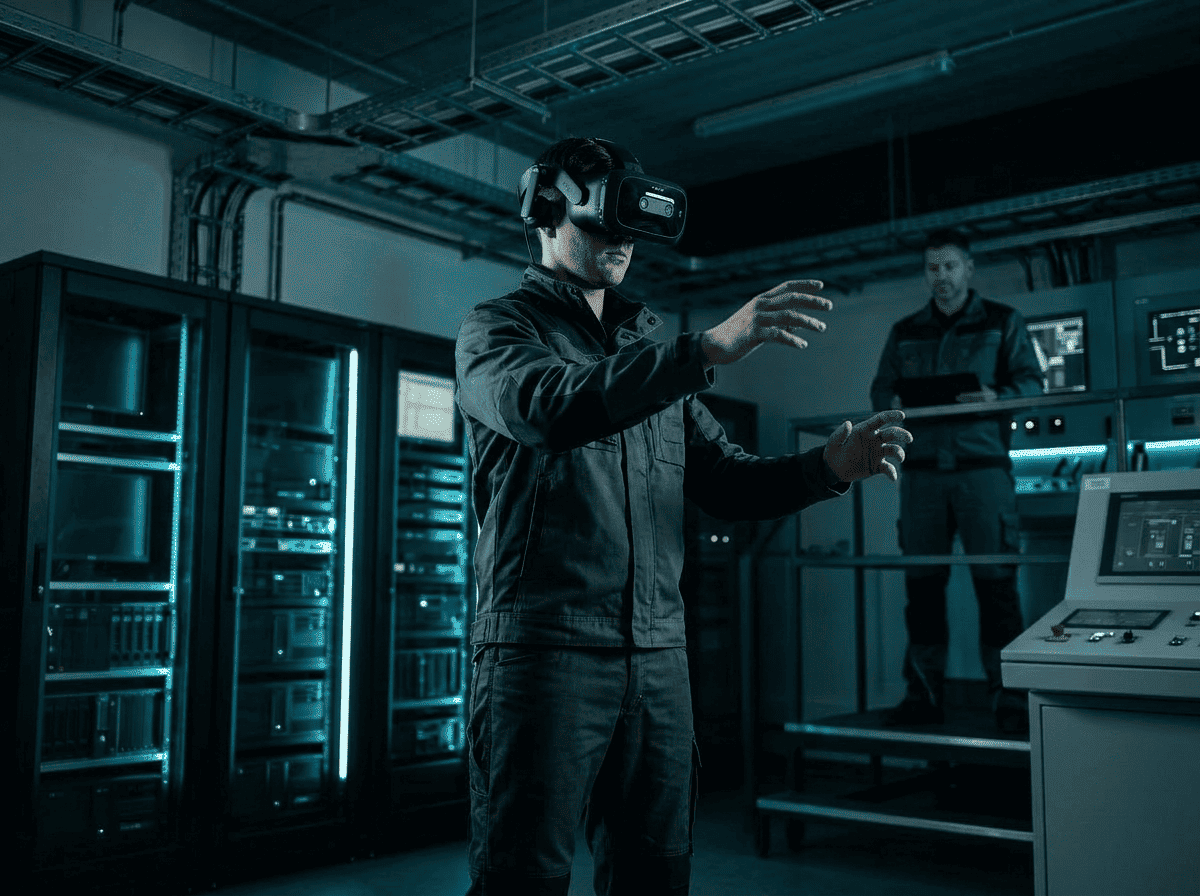
Multiplayer crisis simulations place several people in the same virtual incident at once, each in their own role and each seeing what that role would see. The scenario unfolds in real time, and the outcome depends on how the group communicates and decides, not on any one participant's answers.
That makes it possible to rehearse the three things individual training misses.
Communication under load. Participants pass information through the right channels using shared language, such as the M/ETHANE message format and Joint Decision Model set out in JESIP's Joint Doctrine. Meanwhile the scenario adds noise, conflicting reports and time pressure. Teams discover where messages get lost before it matters.
Handovers. Simulations can deliberately bring new people into a running incident: a shift change, a senior commander arriving, a patient moving between departments. Teams practise passing on situational awareness quickly and accurately, at exactly the point where information most often breaks down.
Leadership under pressure. Commanders practise making and communicating decisions with incomplete information, while others practise supporting or challenging them. Because the scenario responds to each decision, the consequences are visible straight away.
Because these immersive training environments are virtual, participants do not need to be in the same building. A fire control room, an ambulance trust and a local authority can join the same exercise from their own locations. That makes multi-agency practice far easier to schedule and, crucially, to repeat.
Where Team-Based Training Matters Most
Emergency services
JESIP's Joint Doctrine is now on Edition 3.1, and a national review of it opened in 2026. The doctrine is clear; the challenge is making it instinctive. Multiplayer simulations give police, fire and ambulance teams a way to practise joint working regularly, rather than meeting each other's ways of working for the first time at a real incident.
Healthcare
NHS England's core standards for emergency preparedness, resilience and response (EPRR) require, as a minimum, a communications exercise every six months, a tabletop exercise each year, and live and command post exercises every three years. Simulation can strengthen that cycle between the larger exercises, letting clinical, operational and on-call teams rehearse major incident activation, surge response and critical handovers. Established teamwork frameworks such as TeamSTEPPS, from the US Agency for Healthcare Research and Quality, translate naturally into simulated scenarios.
Utilities
Energy and water companies manage incidents that cross control rooms, field crews, contractors, regulators and customers. Under the Civil Contingencies Act 2004, utilities are Category 2 responders with duties to cooperate and share information with emergency services and local resilience forums. Simulations let them rehearse coordination around a major outage or supply incident, including when to escalate and what to tell the public.
Measuring What the Team Actually Did
A team exercise is only as valuable as what is learned from it. The Cabinet Office's Exercising Best Practice Guidance sets out that exercises should be well planned, realistic and challenging, and evaluated so that lessons are identified.
Virtual simulations make that evaluation far richer. Every message, decision and timing can be captured, so debriefs move beyond memory and opinion. Facilitators can replay the moment a handover went wrong, see how long it took to establish a shared picture, or compare how different teams handled the same scenario.
That gives L&D and resilience leads team-level indicators they can track over time:
- Time taken to establish shared situational awareness
- Accuracy and completeness of handovers
- Speed and clarity of escalation decisions
- How often critical information reached the right person
The research supports the investment. A meta-analysis of 129 studies of healthcare team training, published in the Journal of Applied Psychology, found that team training improved reactions, learning, on-the-job behaviour and organisational results. It also found those gains build in sequence: learning leads to transfer, and transfer leads to results.
Train the Team That Will Respond
Major incidents will keep testing the connections between people, teams and organisations. Assessing individuals tells you who is ready. Rehearsing together tells you whether the response will hold. Organisations that make team-based incident response training a regular habit, rather than an annual event, give their people the chance to find the gaps in a simulation instead of on the day.
FabricAcademy's Immersive Experiences bring teams into the same scenario to rehearse communication, handovers and leadership under pressure, wherever they are based. Find out how it works.
Explore Immersive Experiences →