Somewhere in your organisation right now, the exact answer someone needs already exists. It's in a training video nobody's watched since induction, a PDF three folders deep, or a recording of a call your best engineer made six months ago explaining exactly this problem. The knowledge is there. It just isn't where the person who needs it can find it, when they need it.
That gap, between knowledge existing and knowledge being usable, is one of the most expensive problems in enterprise operations. And it's almost entirely invisible on a spreadsheet.
The Searching Tax Nobody Budgets For
Think about how a typical query actually gets resolved in most organisations. Someone has a question. They search their inbox. Nothing useful. They open the intranet or a shared drive and click through a folder structure that made sense to whoever built it two reorganisations ago. Still nothing. So they message a colleague, who either doesn't know either, or takes twenty minutes out of their own day to explain something they've already explained five times before.
Multiply that by every employee, every day, and the numbers get serious. Research from the McKinsey Global Institute found that the average interaction worker spends close to 20 percent of the working week looking for internal information or tracking down colleagues who can help with specific tasks, on top of 28 percent managing email. Scaled up, MyContentScout's own benchmarking puts the cost of that search friction at roughly $2.5 million a year for a 1,000-employee company, with the right tooling capable of returning up to 446 hours per user, per year.
The same McKinsey research points to the fix hiding in plain sight: turning scattered knowledge into a searchable, structured resource can cut the time employees spend hunting for company information by as much as 35 percent. The knowledge doesn't need to be created. It needs to be findable, in whatever format it already lives in.
Four Places Knowledge Gaps Actually Bite
This isn't an abstract inefficiency. It shows up in specific, recognisable moments across every team.
The new starter, week three. They're trying to follow a process that changed since the induction pack was recorded. Nobody's re-filmed the training video. They either guess, or interrupt someone senior to ask.
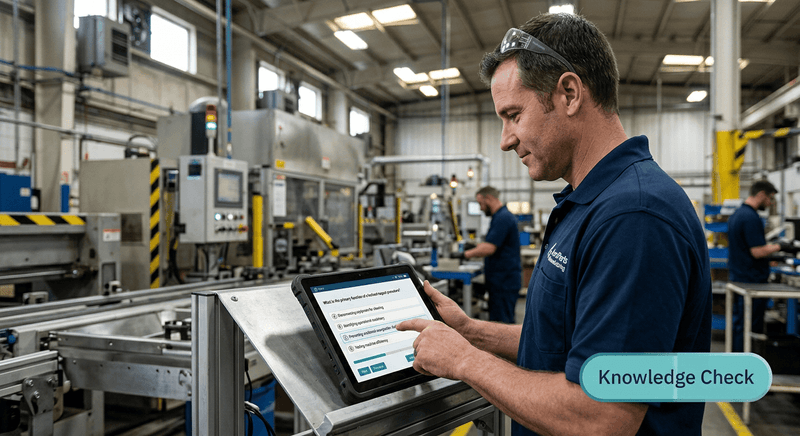
The engineer on site. A piece of equipment is behaving unusually and the answer sits in a technical manual, or in a recorded walkthrough from a previous fault. Neither is quick to search from a phone in the field. Downtime costs money for every minute the answer stays out of reach.
The support agent on a live call. The correct troubleshooting step exists somewhere in the knowledge base, possibly in a document, possibly in a training video with the answer buried at the eleven-minute mark. Finding it fast enough to keep the customer on the line is the whole job.
The manager preparing for a difficult conversation. They know there's a policy that governs this exact situation, but they can't remember whether it lives on the HR portal, in a PDF someone emailed round in 2023, or in a recorded briefing from last year's compliance update.
None of these are knowledge problems. They're access problems. And access problems compound, because content today doesn't just mean documents. It means video, audio, e-learning modules and dashboards too, each one a place an answer can hide.
When the Answer Is in a Video, Not a Document
Traditional search tools were built for text. They work reasonably well on a well-tagged document library and fall apart everywhere else. If the answer to a question lives in the transcript of a training video, or halfway through a recorded webinar, or in an audio briefing from a site visit, keyword search simply can't reach it.
That's a real gap, because organisations increasingly hold as much operational knowledge in video and audio as they do in text. Onboarding sessions, product demos, incident debriefs, expert walkthroughs. All genuinely useful. All effectively invisible to a person typing a keyword into a search bar and hoping.
What "Knowledge at the Point of Need" Actually Means
Knowledge at the point of need is a simple idea with a demanding standard behind it: the right answer, delivered in the moment someone needs it, without them having to know which document, video or folder to look in first.
Not a link to a 40-page manual. Not "try asking someone in that team." An actual answer, drawn from your organisation's real content, in plain language, with the source shown so the person can trust and verify it.
That's the shift an AI Knowledge Platform makes possible. Instead of employees adapting their question to fit a search bar, or a folder structure, or someone else's availability, the system does the work of understanding the question and surfacing the answer, wherever it happens to live.
How MyContentScout Closes the Gap
MyContentScout lets employees ask a question in everyday language and get one instant, cited answer, drawn from across your organisation's documents, videos, audio, images, e-learning and dashboards at once. No special syntax. No keyword guessing. No remembering which system holds the answer.
Every response links back to its exact source, whether that's a page in a policy document or a specific timestamp in a video, so teams can verify what they're being told rather than treating it as a best guess. Ask a question in English and get an accurate answer pulled from a French training video. Ask on a phone in the field and get the same trusted answer you'd get at a desk. The knowledge doesn't change shape depending on how or where someone asks for it.
This isn't about replacing what you already have. MyContentScout connects to the content you've already created, whether that's a document library, a video archive, or a set of departmental training materials, and turns all of it into something employees can actually query. The knowledge you've already invested in producing finally becomes knowledge people can use, at the moment they need it.
The Commercial Case Is Straightforward
Reducing search friction isn't just a quality-of-life improvement for employees, although it certainly is that too. It's hours returned to productive work, every day, across every team. It's fewer errors caused by someone working from an outdated version of a process. It's faster onboarding, because new starters can ask questions instead of waiting for someone to have time to answer them. And with content spread across documents, video and audio, it's the difference between knowledge that technically exists and knowledge that actually gets used.
The knowledge your organisation needs to run better almost certainly already exists somewhere inside it, in whatever format it was created in. The opportunity isn't creating more of it. It's making sure the right person can find the right piece of it, exactly when it matters.
See what MyContentScout can do with your own content, free for 30 days.
Start your free trial at mycontentscout.com