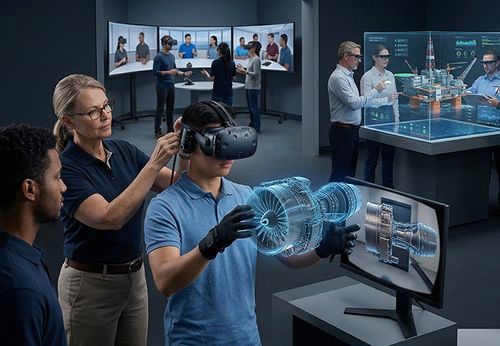
Most equipment training still happens somewhere other than the equipment. A technician reads a manual in a training room, watches a video on a laptop or practises in a headset, then walks onto the shop floor and has to translate all of it onto a real machine with real consequences. Augmented reality training removes that translation step.
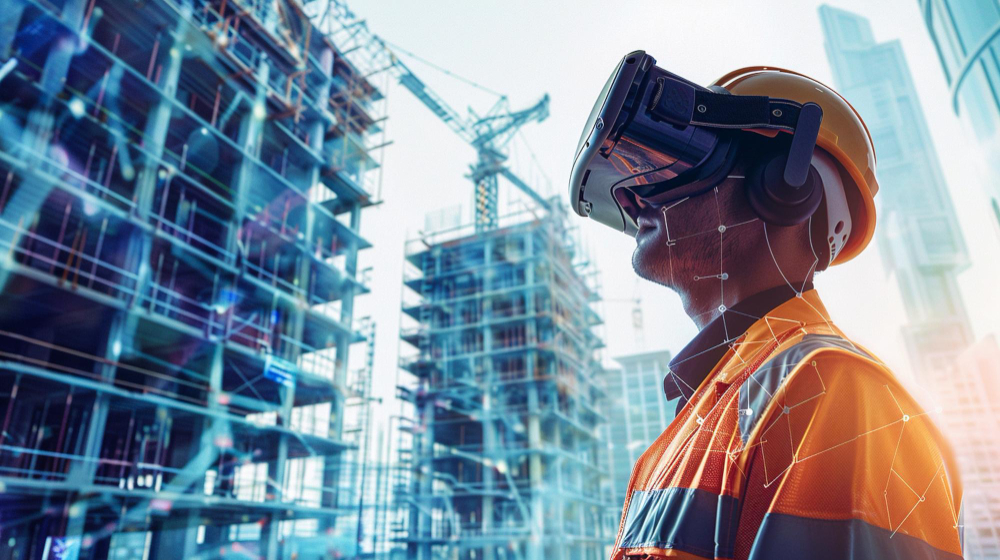
AR overlays place step-by-step instructions, 3D models and safety warnings directly onto the physical asset, viewed through smart glasses, a headset or a tablet. The technician keeps their hands on the work and their eyes on the machine. That makes AR maintenance training a different job from virtual reality, and understanding the difference is what separates a successful immersive training programme from an expensive pilot.
VR Takes People Out. AR Guides Them Through.
VR training builds a complete simulated environment. The learner is removed from the real world and placed inside a replica of it. That is exactly the point: you can rehearse a gas leak, a line fire or a confined space rescue without anyone being at risk, and repeat the scenario until the response is automatic.
AR works the other way round. The real environment stays in view and the digital layer sits on top of it. Instructions appear next to the valve they refer to. An arrow points to the fastener that comes off next. A torque value sits beside the bolt. The learner is not rehearsing the procedure. They are performing it, with guidance.
PwC's Seeing is Believing analysis suggests the larger economic opportunity sits with AR. Of a combined $1.5 trillion boost to global GDP from immersive training and other VR and AR uses by 2030, PwC attributes $1,092.4bn to AR and $450.5bn to VR. The reason is reach. VR is a training environment. AR is a training environment and a working tool at the same time.
Manufacturing: Fewer Errors on Complex Assembly
Manufacturing has the longest track record with AR work instructions, largely because complex assembly punishes small mistakes.
Boeing is the reference case. Writing in Harvard Business Review, Michael Porter and James Heppelmann, then chief executive of PTC, describe how Boeing used AR to show trainees how to assemble an aircraft wing, cutting the time the task took by 35%. At a GE Renewable Energy factory, workers assembling wind turbines with smart glasses recorded a 34% productivity improvement the very first time they used them, compared with working the standard way.
That second figure matters for L&D. The gain appeared on first use, which is exactly when a new joiner, or an experienced technician on an unfamiliar task, is most likely to make mistakes. AR shortens time to competency because the instructions do the remembering.
Utilities: Training Where the Assets Are
Utilities face a skills gap on two fronts. Experienced engineers are retiring, and the assets they maintain are spread across substations, power plants and hundreds of miles of network. Classroom training struggles when the equipment cannot come to the classroom.
The Electric Power Research Institute (EPRI) has spent around a decade developing AR applications for frontline workers. In one study, line workers trained in the field with an AR app installed routers on utility poles 48% faster than workers who learned the task from instructions on index cards.
EPRI's research also flags the practical questions worth planning for: device comfort, field of view and awareness of surroundings when someone is working at height or near live equipment. Workers preferred smaller devices they could flip out of their line of sight. Hardware choice is a training design decision, not just an IT one.
Automotive: Remote Expertise on Every Vehicle
In automotive service, the problem is rarely a lack of training. Modern vehicles change faster than any technician can keep up with, and the specialist who knows the answer is usually in another building, or another country.
Porsche's Tech Live Look connects dealership technicians to remote experts through smart glasses. The expert sees exactly what the technician sees and guides them while they keep both hands on the car. Porsche reported that pilots of the system cut service resolution times by up to 40%.
This is remote expert assistance working as continuous learning. Each guided repair transfers knowledge to the technician, so the next time the same fault appears, they need less help.
From Guided Procedure to Audit-Ready Record
This is where AR moves from a useful training tool to a compliance asset.
In the UK, Regulation 9 of the Provision and Use of Work Equipment Regulations 1998 (PUWER) requires employers to ensure that everyone who uses, supervises or manages work equipment has received adequate equipment training. HSE guidance describes three stages of that training: basic, specific job and familiarisation, which is where maintenance training on a particular asset sits. Quality frameworks such as ISO 9001 go further and ask organisations to retain documented evidence of competence.
Traditional training records struggle to prove any of this. A signed attendance sheet shows that someone sat in a room. It does not show that they can isolate a pump correctly.
AR-guided procedures generate evidence as a by-product of the work. Every step can be logged: who performed it, on which asset, when, how long it took, where they paused and whether they called for help. Checkpoints can require a photo or a confirmation before the next step unlocks. Over time, this builds a record of demonstrated competence on the actual equipment, rather than a record of attendance.
When that data feeds a unified learning analytics layer, the questions auditors and executives ask become answerable in real time. Which technicians are signed off on this line? How long does a new joiner take to reach independent operation? Which steps generate the most errors, and does the procedure need rewriting?
What AR-guided procedures make possible
- ✓ Step-level records of who did what, on which asset, and when
- ✓ Evidence of competence on real equipment, not just course completion
- ✓ Time to competency tracked by role, site and asset type
- ✓ Procedures updated once and published everywhere, with version history
- ✓ Audit-ready training records without manual compilation
- ✓ Error hotspots identified and fed straight back into training design
Choosing the Right Starting Point
The strongest programmes do not start with the technology. They start with a task: one procedure that is high-risk, infrequent or error-prone, where the cost of a mistake is visible. Build the AR guide for that task, measure time and errors before and after, and let the data decide what comes next.
VR still has a place for the scenarios no one should practise for real. But for the everyday work of operating and maintaining equipment, the best training environment is the equipment itself.
FabricAcademy's Immersive Experiences capability brings AR equipment guidance and VR simulation into one learning ecosystem, with every guided step feeding real-time, audit-ready reporting. Find out how it works.
Explore Immersive Experiences →